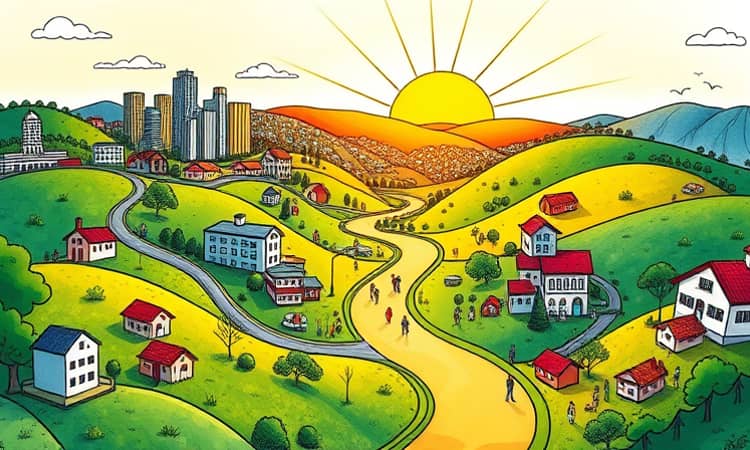
In a world often fixated on financial metrics, true prosperity emerges as a beacon of hope, calling us to look beyond mere numbers.
It is a dynamic state where an open economy harnesses ideas and talent to uplift communities, ensuring that growth benefits everyone, not just a select few.
This journey invites you to explore pathways that blend innovation with empathy, creating a future where well-being is broadly shared and sustainable.
By understanding the core principles of prosperity, we can navigate personal and collective economic challenges with confidence and clarity.
This article will guide you through definitions, frameworks, and actionable strategies to inspire your own prosperity journey.
Redefining Prosperity Beyond Wealth
Prosperity is not solely about accumulating riches; it encompasses a balanced approach to life that includes material sufficiency, social equity, and ecological health.
At its heart, it means building inclusive societies with strong social contracts, where trust and community support foster resilience and opportunity for all.
This broader view moves past GDP to include dimensions like health, education, and environmental quality, empowering individuals to thrive in their lived experiences.
By embracing this holistic perspective, we can shift from short-term gains to long-term sustainability, ensuring that prosperity endures for generations.
It’s about creating a world where everyone has the chance to contribute and benefit, making our collective journey more meaningful.
The Core Frameworks of Prosperity
Several frameworks help structure our understanding of prosperity, offering clear pillars to guide policy and personal action.
The Legatum Prosperity Index, for example, breaks it down into three key domains: Inclusive Societies, Open Economies, and Empowered People.
These domains are supported by 12 pillars and 67 policy elements, providing a comprehensive roadmap for assessment and improvement.
- Inclusive Societies: Focus on governing institutions with integrity, rule of law, and stable families that build trust and shared values.
- Open Economies: Emphasize investment environments, enterprise conditions, infrastructure, market access, and economic quality to foster competition and innovation.
- Empowered People: Center on living conditions, health, education, and the natural environment to enhance autonomy and well-being.
Another influential blueprint is Prosperity Economics, which advocates for long-term growth through job creation, security for workers, and accountable democracy.
This approach critiques austerity policies that stifle progress and instead champions public investments and reforms to rebuild the middle class.
- Invest in infrastructure to create jobs and stimulate economic activity.
- Enhance worker security through bargaining rights and fair wages.
- Promote democratic accountability to ensure policies reflect broad societal needs.
Understanding these frameworks equips us with tools to evaluate and shape prosperity in our own contexts, from local communities to global systems.
Economic Pathways and Models
Different economic models offer varied pathways to prosperity, each with unique drivers and examples from history and modern practice.
These models highlight how nations and individuals can leverage capital, technology, and coordination to achieve sustainable growth.
These models underscore that prosperity is not one-size-fits-all; it requires adapting strategies to specific contexts and challenges.
For instance, latecomer economies might focus on adopting existing technologies, while advanced ones prioritize innovation to stay competitive.
By studying these pathways, we can identify which elements resonate with our own goals, whether in personal finance or community development.
Policy Strategies for Collective Prosperity
Effective policies are crucial for translating frameworks into reality, offering both immediate relief and long-term transformation.
Immediate actions might include infrastructure investments to boost employment and debt relief for homeowners facing financial strain.
Long-term strategies should focus on public investment in innovation, job quality, and financial regulation to prevent crises and promote stability.
- Support education and technology to foster entrepreneurship and skill development.
- Implement monetary policies aimed at full employment to reduce inequality.
- Advocate for fair taxation on the wealthy to fund public services and reduce disparities.
Political engagement is also key, as organizing communities—such as workers or minority groups—can counter unequal policies and amplify diverse voices.
Geographic and external factors, like climate and location, influence prosperity pathways, reminding us to consider local contexts in planning.
By championing these strategies, we can build accountable democracy that strengthens middle class, ensuring that growth is inclusive and resilient.
The Sustainability Shift to Circular Economy
A critical aspect of modern prosperity is the shift from linear to circular economic models, which prioritize ecological health and resource efficiency.
Linear economies follow a take-make-dispose pattern, leading to resource depletion and environmental harm.
In contrast, circular economies emphasize regeneration, waste elimination, and product longevity, aligning prosperity with planetary well-being.
- Use renewable materials to reduce environmental impact.
- Design products for repair and reuse to extend lifespans.
- Internalize environmental costs to promote sustainable practices.
This transition supports sustained well-being balancing material sufficiency, making prosperity not just about today’s gains but future generations’ health.
By adopting circular principles, individuals and businesses can contribute to a more equitable and resilient world, where economic activity harmonizes with nature.
Personal Navigation on the Prosperity Pathway
Navigating your own economic journey involves applying these principles to daily life, with practical steps to enhance personal and community prosperity.
Start by assessing your current situation: consider your skills, financial health, and support networks to identify areas for growth.
Engage in continuous learning to stay adaptable, whether through formal education, online courses, or community workshops.
- Build financial security by saving, investing wisely, and planning for emergencies.
- Participate in local initiatives to strengthen community bonds and advocate for fair policies.
- Embrace sustainable habits, such as reducing waste or supporting eco-friendly businesses.
Remember that prosperity is a collaborative effort; by sharing knowledge and resources, we can lift each other up and create broader benefits.
Stakeholders like Richard Trumka and Jacob Hacker emphasize that prosperity means jobs and investment, highlighting the importance of collective action.
As you move forward, keep in mind that the path may be winding, but with perseverance and a focus on shared values, you can achieve a fulfilling economic journey.
Ultimately, prosperity is about more than individual success—it’s about crafting a legacy of hope and opportunity for all.