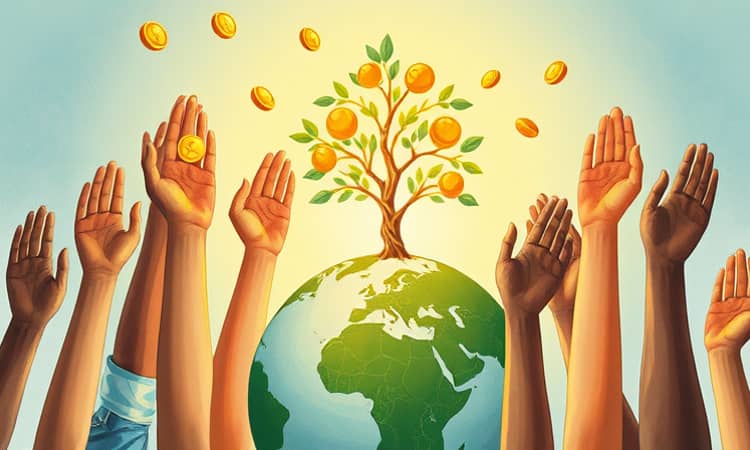
In a world defined by towering skyscrapers of fortune and hidden pockets of scarcity, the gap between wealth and need can feel both overwhelming and immutable. Yet, history reveals that transformative change often emerges from the simple act of giving—when those with means choose to invest not only in markets, but in people, communities, and the planet. This is a call to purpose, a reminder that prosperity truly multiplies when shared.
While statistical charts paint one narrative, the lived experiences of individuals tell another. Every philanthropic gesture, large or small, becomes a thread in a larger tapestry of hope, resilience, and collective progress.
Understanding Global Wealth Disparities
The current landscape of global wealth is stark: the top 10% own 75% of global wealth, while the bottom half of humanity controls a mere sliver. This concentration has intensified since the 1990s, as the ultra-rich accumulate assets at nearly double the rate of the poorest. These figures underscore an urgent truth: economic growth alone will not bridge yawning divides.
Such disparities are not abstract; they manifest in everyday lives, limiting educational prospects, healthcare access, and the chance to flourish in a rapidly changing world.
Over the past three decades, the share of global wealth held by the top 0.001% has grown steadily, illustrating deepening concentration. This accumulation creates an environment where capital begets more capital, leaving ordinary incomes stagnating. Yet, when philanthropic pioneers redirect a fraction of their fortune toward systemic solutions, they unlock possibilities for marginalized groups to innovate, learn, and thrive in unexpected ways.
Stories abound of community-led initiatives powered by ethical investment—rural schools transformed by solar panels, urban health clinics funded by social bonds, and countless microenterprises founded by women reinvesting profits locally. Each success underscores that wealth can be a force for expansive growth rather than contraction.
The Environmental and Educational Divide
Responsibility for climate impacts also follows lines of wealth. The wealthiest 10% are linked to roughly 77% of private emissions, yet the poorest communities face the harshest consequences—floods, droughts, and resource scarcity. Meanwhile, education budgets mirror these imbalances, cementing future inequalities before a child writes their first word.
In Sub-Saharan Africa, a child’s educational journey begins with a fraction of the investment made in wealthier regions. These gaps are not just statistics, but barriers that define destinies.
Climate vulnerability and educational deficits often intersect. In regions where drought threatens harvests, children are pulled from school to support family livelihoods. Bridging these divides means addressing both emissions and opportunity gaps hand in hand with communities, ensuring that solutions are culturally grounded and locally led.
Political and Financial Barriers to Equality
Wealth concentration extends its influence into tax systems and political arenas. In many countries, effective tax rates decrease for those who can pay the most, undermining public services they could otherwise support. Magnified by concentrated campaign donations, policy priorities often tilt toward preserving privilege rather than expanding opportunity.
- Weakening progressive taxation undermines public investment
- Net income transfers favor wealthy nations annually
- Concentrated political donations amplify elite voices
Together, these dynamics create a feedback loop where power begets more power, and communities with the least remain voiceless.
Paths to Positive Impact
Yet, the story does not end in resignation. Historical and contemporary examples show that strategic interventions can reshape the trajectory of inequality. Programs combining progressive taxation and redistributive transfers have produced measurable gains in social well-being, while robust welfare systems serve as bulwarks against extreme poverty.
- Implement progressive taxation policies
- Invest in quality education and healthcare
- Support transparency in campaign finance
- Harness impact investing for social returns
These measures require collaboration: governments, business leaders, and civil society must align incentives with the broader common good.
Taking Action: How You Can Give Back
Beyond policy, every individual can contribute to a fairer world. Philanthropy is not solely for billionaires; creative giving and conscious engagement are within reach of anyone with purpose and commitment. By channeling resources thoughtfully, we can generate ripple effects that echo across generations.
- Volunteer or donate to grassroots organizations
- Support social enterprises in emerging communities
- Advocate for equitable tax reform
- Adopt sustainable consumption habits
Every action, from mentoring a young student to lobby efforts for climate resilience, compounds into transformative momentum. The aggregated kindness of many can shift systems once deemed unchangeable.
Imagine a world where the fruit of abundance is shared equitably, where every child’s potential is nourished by both the environment and education, and where trust in systems is rebuilt through transparency and solidarity. This vision is within reach—if we harness our collective will and resources to give back, today and every day.