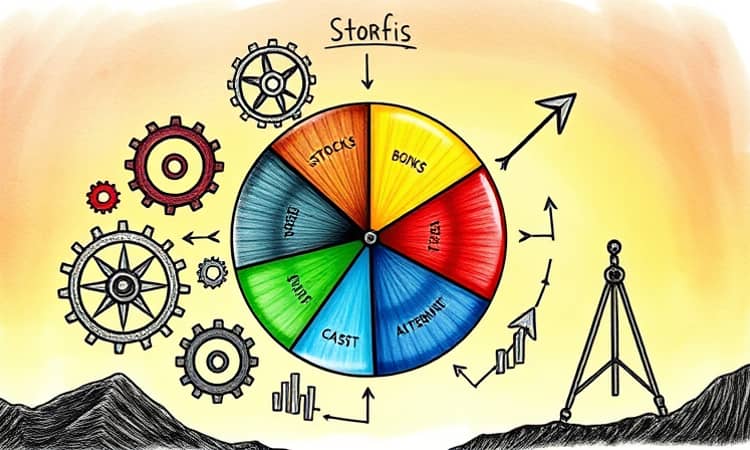
In a world of market uncertainty, a well-defined asset allocation strategy acts as your portfolio’s foundation, guiding decisions and fostering long-term success.
Understanding Asset Allocation
At its core, asset allocation determines how you divide investments across major asset classes—stocks, bonds, and cash. This process aims to balance risk and return by combining assets that behave differently under various market conditions.
Anything outside those three categories, such as real estate, commodities, private equity, and art, falls under alternative assets. By including these, investors can tap into additional sources of diversification and unique risk premia.
Academics and practitioners alike regard asset allocation as one of the most important drivers of long-term portfolio performance, often outweighing stock selection or market timing.
The Pillars of Your Portfolio
Each asset class plays a distinct role in shaping the risk and return profile of your investments. Recognizing these roles helps you build a portfolio tailored to your objectives.
- Equities / Stocks: The primary growth engine, equities offer the highest potential returns but come with increased volatility and drawdown risk.
- Fixed Income / Bonds: Bonds provide steady income and help stabilize returns, typically exhibiting lower volatility than stocks.
- Cash and Cash Equivalents: Including money market funds and Treasury bills, cash ensures liquidity and capital preservation.
- Alternative Assets: Real estate, commodities, currencies, and private markets can reduce portfolio correlation and reduce the volatility and drawdowns.
Diversification and Risk Management
Diversification lies at the heart of effective asset allocation. By spreading investments across uncorrelated assets, you can smooth the ride and mitigate the impact of any single market shock. Different asset classes respond uniquely to economic shifts—when equities slump, bonds or commodities may hold steady or rise.
The risk/return trade-off is shaped by allocation choices. A portfolio with 80% stocks and 20% bonds will likely deliver higher long-term returns but endure sharper declines in bear markets than a 20% stocks and 80% bonds mix. Your exposure to potential gains and losses must align with your personal tolerance and financial capacity.
Over time, your allocation should evolve. Younger investors often favor aggressive mixes to capture growth, while those nearing retirement may prioritize capital preservation and income.
Aligning Allocation with Your Profile
Asset allocation becomes truly effective when tailored to your unique situation. Three key factors inform your blueprint:
- Goals and Objectives: Whether you are saving for retirement, funding education, or building wealth, each goal demands a specific return target and risk approach.
- Risk Tolerance vs Risk Capacity: Emotional comfort with volatility differs from financial ability to absorb losses. Both must be considered to prevent impulsive decisions during market downturns.
- Time Horizon: A longer investment timeframe allows more scope for recovery after downturns, warranting higher equity exposure. Short-term goals typically call for conservative mixes.
Consider Joe, a 30-year-old planning for retirement in five years. Starting with $10,000, his advisor recommends a 50% stocks, 40% bonds, and 10% cash allocation. As Joe’s risk tolerance grows, he gradually shifts toward a 65/35 stocks/bonds mix, illustrating how allocations adapt to changing circumstances.
Model Portfolios and Implementation
Many firms offer model portfolios to simplify allocation choices. These templates, based on risk levels, provide ready-made blueprints:
Providers like Vanguard and PIMCO leverage diversified, low-cost index funds to implement these strategies. Target-date and balanced funds automatically adjust allocations over time, offering simplicity for hands-off investors.
Asset Allocation Strategies
Investors can choose among various allocation styles to meet their objectives. The most common approaches include:
Strategic asset allocation: Establishes a long-term target mix aligned with goals and risk profile. Rebalancing occurs periodically to maintain these targets, driven by an Investment Policy Statement.
Tactical asset allocation: Introduces short-term tilts around strategic weights, leveraging market signals to capture opportunities or avoid risks.
Constant-weight allocation: Rebalances whenever allocations drift beyond set bands, ensuring consistency with the original plan.
Insured asset allocation: Guarantees a minimum portfolio value by combining growth assets with protective instruments, suitable for conservative objectives.
Advanced Concepts and Governance
Beyond traditional classes and strategies, investors can incorporate factor-based approaches, tilting toward size, value, momentum, or quality factors to enhance returns. The global market portfolio concept extends diversification by allocating across all investable regions and asset types according to market capitalizations.
Institutional investors formalize these decisions through governance frameworks. An Investment Policy Statement outlines objectives, target ranges, rebalancing rules, and reporting protocols. Regular reviews ensure the allocation remains aligned with evolving market conditions and investor needs.
Rebalancing and Implementation Choices
Effective implementation covers not just the target mix but also rebalancing and execution methods. Investors choose between calendar-based rebalancing and threshold triggers, balancing transaction costs against deviation risks. Tax-aware strategies place higher-yield assets in tax-advantaged accounts and use tax-loss harvesting to improve after-tax returns.
Tools range from individual securities to mutual funds, ETFs, and managed accounts. The choice depends on cost, flexibility, and sophistication. Digital advisors automate these processes, providing discipline and transparency for smaller portfolios.
Conclusion
Mastering asset allocation empowers you to navigate markets with confidence, crafting a portfolio that reflects your goals, risk tolerance, and timeline. By understanding the roles of different asset classes, adopting the right strategy, and maintaining disciplined rebalancing, you lay the groundwork for pursuing target long-term returns while safeguarding against volatility. Your blueprint evolves over time, ensuring that your financial journey remains aligned with your aspirations and life stages.