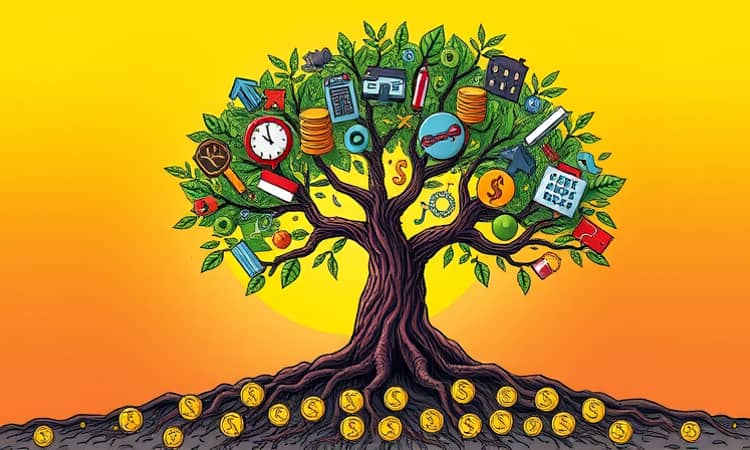
Every journey toward financial freedom begins with a single step: deciding to put your money to work. Too often, savings sit idle, losing purchasing power as inflation quietly erodes value. With deliberate action and a clear plan, you can transform simple savings into exponential capital growth over time, empowering you to achieve dreams and safeguard your future.
The Foundations of Wealth Creation
Investing is more than buying stocks or bonds; it is a commitment to your long-term goals. Understanding fundamental principles ensures you remain steady during market turbulence.
Inflation versus cash savings is the first battle. Annual inflation in developed markets typically ranges between 2–4%, while many checking accounts yield near zero. Over a decade, this gap compounds into a significant shortfall.
The power of compounding cannot be overstated. By reinvesting returns, your capital grows exponentially. Consider the “Rule of 72,” which estimates that at a 7% annual return, your investment doubles roughly every ten years.
Every additional decade, your capital nearly doubles, illustrating how long-term growth engine strategies can transform modest savings into life-changing sums.
Central to investing is the risk–return tradeoff: higher potential returns come with greater volatility. Stocks, for instance, outpace bonds over decades but can swing dramatically in the short term. Matching your asset choices to your time horizon and goals preserves peace of mind.
The Current Investing Landscape
In 2024–2025, participation continues to climb. Approximately 58% of U.S. households invest in equities, with 63% of Boomers and 45% of Gen Z building portfolios. Yet the average age to begin investing remains 30, signaling untapped potential among younger savers.
Globally, foreign direct investment flows reached $297 billion in Q1 2024, and despite an 11% fall to $1.5 trillion for the year, projections show a 4.9% rebound in 2025. Public and private sectors poured nearly $33 trillion into trade and infrastructure in 2024, fueling opportunities from logistics to clean energy.
Market performance offers lessons in both triumph and caution. From the pandemic low in March 2020, the S&P 500 surged 183%, while tech stocks soared 288%, revealing the rewards of growth sectors—and the risks of concentration. As 2025 dawned, U.S. equities eased, international stocks outperformed, and bonds rallied on rate-cut hopes.
A balanced 60/40 portfolio weathered the high-volatility environment with only a mid-single-digit drawdown, underscoring the resilience of diversification in uncertain times.
Diversification and Asset Allocation
Asset allocation is your strategic blueprint. Diversification spreads risk across different investments, aiming to reduce portfolio risk and volatility while preserving return potential.
- Equities: your primary growth engine, via large-, mid-, and small-cap stocks across sectors.
- Bonds: income and defensive ballast, mixing government and corporate issues.
- Real estate: direct property or REITs for income and inflation protection.
- Commodities & gold: crisis hedge and inflation shield.
- Cash & equivalents: liquidity for emergencies and short-term goals.
- Alternatives: private equity, infrastructure, crypto—diversifiers for sophisticated portfolios.
Within each class, spread exposure across regions: domestic stability paired with emerging-market growth. Many investors hold 77.5% of equities in U.S. stocks, a home-country bias that may omit high-growth opportunities abroad.
Over time, allocations drift as some assets outperform. Through periodic rebalancing, you restore your target mix and maintain your intended risk profile.
Common Behavioral Pitfalls
Even a sound plan can be undone by human impulses. Recognize and avoid these traps:
- Chasing past performance: buying high after a rally and selling low after a slump.
- Overtrading: excessive trading fees and tax costs erode returns.
- Market timing: attempting to predict peaks and troughs often backfires.
- Herd behavior: following the crowd into speculative bubbles.
- Neglecting rebalancing: allowing drift to inflate risk.
Practical Steps to Begin Your Journey
Taking action transforms knowledge into results. Follow a step-by-step roadmap:
- Define your goals: retirement, home purchase, education, or legacy.
- Assess your risk tolerance: honest reflection on how much volatility you can endure.
- Determine your time horizon: longer horizons justify higher equity allocations.
- Choose an allocation: a starting point like 60/40 or adjusted to your comfort.
- Select low-cost funds or ETFs: broad market exposure with minimal fees.
- Open an account: brokerage, retirement, or digital platform—whichever suits you.
- Automate contributions: dollar-cost averaging helps smooth market swings.
- Review and rebalance annually: keep your plan on track.
By following these steps, you turn intention into impact. Each contribution becomes a building block of your future wealth.
Investing is a deeply personal journey, shaped by your dreams and discipline. While markets ebb and flow, the principles of long-term planning, strategic diversification, and emotional resilience remain steadfast. Embrace the process, stay curious, and let time work in your favor.
Your financial legacy awaits. Take the first step today, and watch your money grow wisely over the years to come, carrying you toward the life you envision.