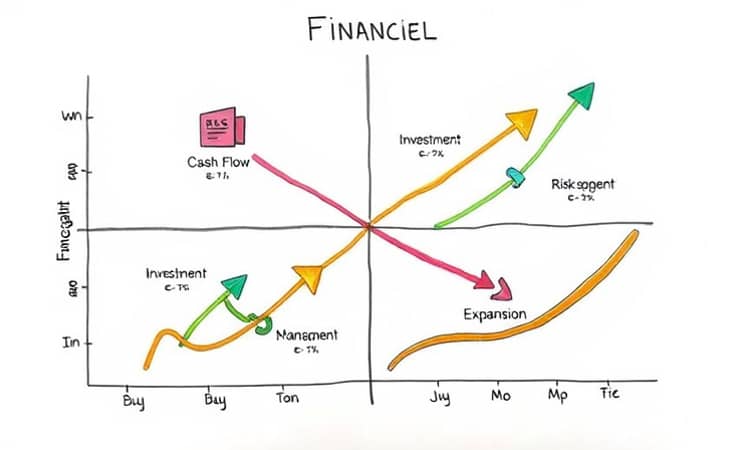
In today’s competitive landscape, businesses can no longer rely on guesswork. To achieve sustainable business scaling with superior profit, liquidity, and market control, leaders need a clear framework. The Growth Grid transforms ambition into measurable paths, guiding every financial lever toward predictable success.
Defining Financial Strategy and the Growth Grid
A robust financial strategy aligns capital structure, revenue targets, and risk profile to overarching objectives. By weaving together forecasting, variance analysis, and scenario planning, organizations gain clarity on their next move. Yet too often, plans remain buried in spreadsheets—leaving growth to chance.
The Growth Grid offers a visual, structured roadmap, mapping cash flow optimization, capital deployment, and investment levers into a single matrix. It contrasts accidental growth with a deliberate, predictable trajectory—turning high failure rates into success stories.
Statistics underscore the need: high-growth firms in the U.S. fell from nearly 20% in 1978 to below 13% by 2020, while 82% of business collapses stem from poor cash flow management.
Setting SMART Financial Goals
SMART goals—Specific, Measurable, Achievable, Relevant, and Time-bound—anchor the Growth Grid in reality. They provide clear milestones for revenue, costs, market reach, and liquidity. Below is a sample structure for crafting these targets:
Financial Analysis and Planning
Before deploying resources, conduct a thorough review of revenue streams, expense categories, and key performance indicators. Classify costs into fixed (rent, utilities) and variable (wages, supplies), then layer in marketing and technology investments to anticipate future needs.
- Rolling 12-18 month budgets with monthly updates
- Zero-based quarterly reviews to eliminate waste
- KPI-tied dashboards for real-time insights
Projections should evolve in complexity: monthly for Year-1, quarterly for Years 2-3, and annual forecasts for Years 4-5. Multi-scenario modeling links revenue drivers to capital expenditures, staffing, and marketing spend—ensuring agility under different market conditions.
Cash Flow Management and Liquidity
Cash flow is the bedrock of stability. Adopting 13-week rolling forecasts keeps your finger on the pulse of inflows and outflows. Incentivize early payments, automate accounts payable, and secure revolving credit lines covering at least two months of expenses.
- Shorten receivables with incentives to boost liquidity
- Dynamic inventory benchmarking to free up capital
- Supplier discount programs for cost savings
Maintain reserves equal to three months of fixed costs and planned capital expenditures, parked in laddered Treasury bills or other liquid instruments. This cushion safeguards against unexpected downturns and funding gaps.
Resource Allocation and Investment
Not all expenditures drive equal returns. Map each cost to its revenue potential using net present value, internal rate of return, and hurdle rate metrics. Rank initiatives to channel resources toward the highest-impact opportunities.
Key investment areas include:
- Technology upgrades that cut costs by 15-30%
- Talent acquisition to boost productivity and innovation
- Market expansion to diversify revenue streams
Adopt a disciplined reinvestment policy, allocating a fixed percentage of profits to research and development, pilot programs, and strategic innovation tranches—ensuring continued momentum.
Capital Raising and Leverage
Determining the right mix of equity and debt is critical. Use term debt for tangible assets and equity for long-cycle bets, while monitoring leverage ratios against covenant thresholds. Sequence fundraising to coincide with milestone achievements, minimizing dilution and maximizing valuation.
For example, reducing debt costs from 4.9% to 4.7% year-over-year can boost distributable income by over 7%—translating millions in additional returns for stakeholders.
Risk Management and Controls
Embedding risk management into the Growth Grid ensures resilience. Conduct scenario and stress testing to uncover vulnerabilities in liquidity ratios and market exposures. Establish early-warning indicators and hedge key risks.
Rigid controls—segregation of duties, automated reconciliations, and dual authorization—protect assets and enhance financial integrity. Companies tightening allocation controls witnessed a 7.9% rise in corporate profits in 2024.
The CFO’s Role and Strategic Alignment
The CFO is the architect of the Growth Grid, translating visionary goals into executable targets. By designing IRR thresholds and crafting financing structures, the CFO aligns financial planning with operations, sales, and product development.
Organizations with this level of integration grow 30% faster, outpacing peers who lack a unified roadmap.
Identifying Opportunities for Accelerated Growth
Leverage forensic financial reviews to spot margin expansion, pricing power, and market niches. Analyze gross margins by segment, benchmark against competitors, and validate market-sizing assumptions. These insights fuel smarter decisions and unlock hidden potential.
With the Growth Grid as your compass, you can weather economic headwinds, seize expansion opportunities, and chart a course toward true financial domination.
Embark on this journey today by mapping your own Growth Grid. Transform uncertainty into clarity, and watch your business ascend to new heights.