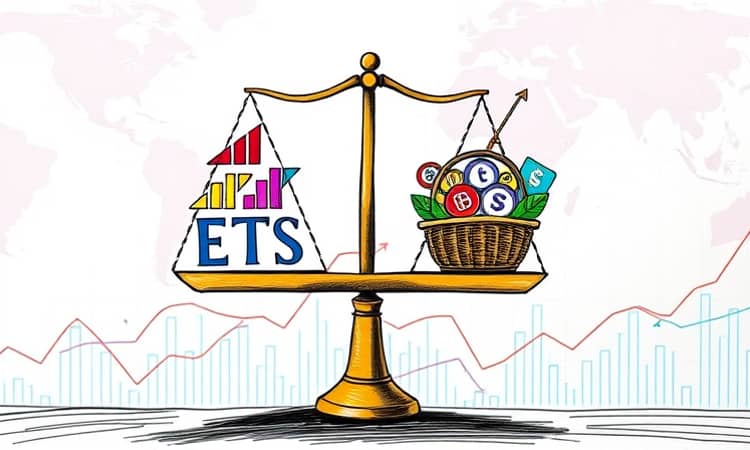
As investors navigate a sea of options, understanding the nuances between Exchange-Traded Funds (ETFs) and mutual funds is crucial. Each vehicle offers distinct benefits that can shape your portfolio’s performance and tax profile.
This article will guide you through definitions, structural differences, cost comparisons, tax implications, and practical decision frameworks so you can choose with confidence.
Core Definitions and Shared Benefits
At their core, both ETFs and mutual funds serve as diversification and professional management tools by pooling investor capital to hold baskets of securities. This collective structure provides small investors with broad market access without selecting individual stocks or bonds.
- Broad markets like the total U.S. stock market
- Major indexes such as the S&P 500 and Nasdaq 100
- Sectors including technology, healthcare, and energy
- Asset classes spanning stocks, bonds, REITs, and commodities
- International and emerging-market exposures
Both vehicles can target growth, income, or factor-based strategies, and they often serve as core holdings in diversified portfolios. Understanding these similarities lays the foundation for deeper exploration of their distinctions.
What Are ETFs?
An ETF, or exchange-traded fund trading structure, is a pooled investment that trades on a stock exchange throughout the trading day. Prices fluctuate in real time, allowing investors to buy or sell shares at the current market price.
- No minimum investment beyond the price of one share or available fractional shares
- Intra-day liquidity and price transparency via visible bid-ask spreads
- Typically passive index tracking, though active ETFs are growing fast
- Efficient creation/redemption mechanisms to align share supply with investor demand
The unique creation/redemption process with APs (authorized participants) often uses in-kind transfers of securities, making ETFs especially tax-efficient in taxable accounts.
What Are Mutual Funds?
Mutual funds pool capital from investors and are priced once daily based on their net asset value pricing (NAV). All buy and sell orders execute after market close at that NAV per share.
- Flat minimum investments, commonly $1,000–$3,000 for retail share classes
- Automatic investment plans and fractional shares in many retirement plans
- Wide range of active strategies led by fund managers
- No intraday trading or bid-ask spreads; transactions always at end-of-day NAV
Redemptions require the fund company to sell underlying securities or hold cash, potentially triggering capital gains that are passed to remaining investors.
Active vs. Passive Management
It’s essential to distinguish the investment vehicle (ETF vs. mutual fund) from the management strategy (active vs. passive). Most ETFs are passive and mirror specific indexes, while mutual funds have a long history of active management.
Passive vehicles aim to match benchmark returns at a minimal cost, capitalizing on broad market efficiency. In contrast, active approaches strive to outperform benchmarks net of fees through security selection, though studies show many underperform net of fees over the long term.
Vehicle choice should align with your strategic outlook: passive funds suit investors seeking broad market exposure without stock picking, while active funds attempt to outperform benchmarks and navigate volatility in real time.
Comparing Costs and Fees
Costs can significantly impact your returns over time. Below is a side-by-side comparison of average fee structures:
Beyond expense ratios, ETFs incur trading costs like bid-ask spreads and any broker commissions, while mutual funds may have sales loads or redemption fees on certain share classes. The annual difference of even 0.30% on a $100,000 portfolio can lead to a long-term compounded dollar impact of tens of thousands of dollars over decades.
Tax Efficiency Considerations
One of the most compelling advantages of ETFs in taxable accounts is their structural tax efficiency. In-kind redemptions allow ETFs to remove low-cost-basis shares without selling securities, thus minimizing capital gains distributions to shareholders.
By contrast, mutual funds often sell holdings to meet redemptions, realizing gains that must be distributed to all investors. In a typical year, only about 5% of ETFs distribute capital gains, versus roughly 43% of mutual funds.
That said, index mutual funds with low turnover can approach ETF-like tax efficiency, and some active fund managers employ tax-management techniques to mitigate taxable events. In tax-sheltered accounts, however, these advantages become moot.
Accessibility and Minimum Investments
For investors starting with modest sums, ETFs offer a clear edge: you need only the cost of one share, or even less with fractional-share platforms. This opens doors to diversified strategies for those investing as little as $50 or $100.
Mutual funds traditionally require initial investments in the low thousands, though many retirement plans and robo-advisors have reduced or eliminated these barriers. When consistent automatic contributions and payroll deductions are key for disciplined saving, mutual funds still shine.
While ETFs require a brokerage account, modern apps have streamlined purchases, making them nearly as accessible as mutual funds offered within workplace retirement plans.
Which Should You Choose?
Your best choice depends on your individual goals, account type, and trading preferences. Consider whether you’re investing taxable dollars where minimizing distributions matters, your need for intraday access to adjust positions quickly, and whether you prefer automated, regular investments through payroll deductions.
For taxable brokerage accounts, ETFs often win on tax efficiency and flexibility, while mutual funds may suit retirement plans and hands-off savers who value simplicity and no trading commissions. Ultimately, combining both—using low-cost index mutual funds for core retirement savings and ETFs for satellite tilts—can harness the strengths of each vehicle.
By weighing structure, cost, tax implications, and accessibility against your personal investing blueprint, you can craft a portfolio designed to thrive in any market environment.